The Quiet Majesty: A Gardener’s Journey Through the Imperial Palace Grounds
My first encounter with the Imperial Palace Gardens wasn’t in a book or a documentary. It was through the soles of my feet, feeling the subtle crunch of shirakawa-suna—the brilliant white gravel that carpets the outer grounds. I was a young, overly confident landscape architecture student, armed with theories of Western design principles. I thought I understood space, form, and beauty. Walking from the bustling, modern chaos of Tokyo’s Marunouchi district through the Nijubashi bridge into that vast, silent expanse was a humbling slap to my senses. It wasn’t just a park; it was a statement in negative space, a lesson in restraint that would fundamentally reshape my entire approach to design. That day, I stopped being just a student of gardens and began a lifelong apprenticeship to a philosophy.
More Than a Backyard: The Historical Weight of the Kōkyo
To call the Imperial Palace Gardens simply the “grounds” of the Emperor’s home is to profoundly miss the point. This is the Kōkyo, the heart of a historical narrative that spans from feudal fortresses to a modern symbol of a nation. The current palace sits within the innermost ring of what was once Edo Castle, the seat of the Tokugawa shogunate for over 250 years. When you walk here, you’re treading on layers of history. The massive, moss-covered stone walls, assembled without mortar by master craftsmen, speak of a time of war and power. The wide moats, now home to swans and carp, were formidable defensive barriers.

The transformation from a military citadel to a serene, public-facing garden is, in itself, the story of modern Japan. After the Meiji Restoration in 1868, the Emperor moved from Kyoto to Edo, which was renamed Tokyo. The castle became the Imperial Palace. Much of the inner grounds are private, but the Eastern Gardens (Higashi Gyoen), opened to the public in 1968, allow us into a portion of this hallowed space. This wasn’t merely about creating a pretty garden; it was an act of cultural re-contextualization, turning a symbol of martial rule into one of peaceful, democratic sovereignty. Understanding this context is crucial. You’re not just looking at plants and rocks; you’re witnessing a landscape that has consciously evolved to embody a nation’s changing identity.
The Grammar of Silence: How the Garden “Works”
Western gardens often work by addition. We add flower beds, fountains, and statues to assert our will upon nature. The Imperial Palace Gardens, and Japanese garden design at its core, operates on a principle of subtraction and profound editing. It’s a visual language with a strict, though unspoken, grammar.
First, there’s the masterful use of borrowed scenery (shakkei). The gardens never feel like a closed set. Your eye is deliberately drawn beyond the walls to the modern skyscrapers of Otemachi or the concrete bulk of the Budokan. This isn’t an accident or a compromise. It’s a deliberate framing device that places the timeless, manicured serenity of the garden in a dynamic conversation with the rushing present of Tokyo. It acknowledges change and permanence simultaneously.
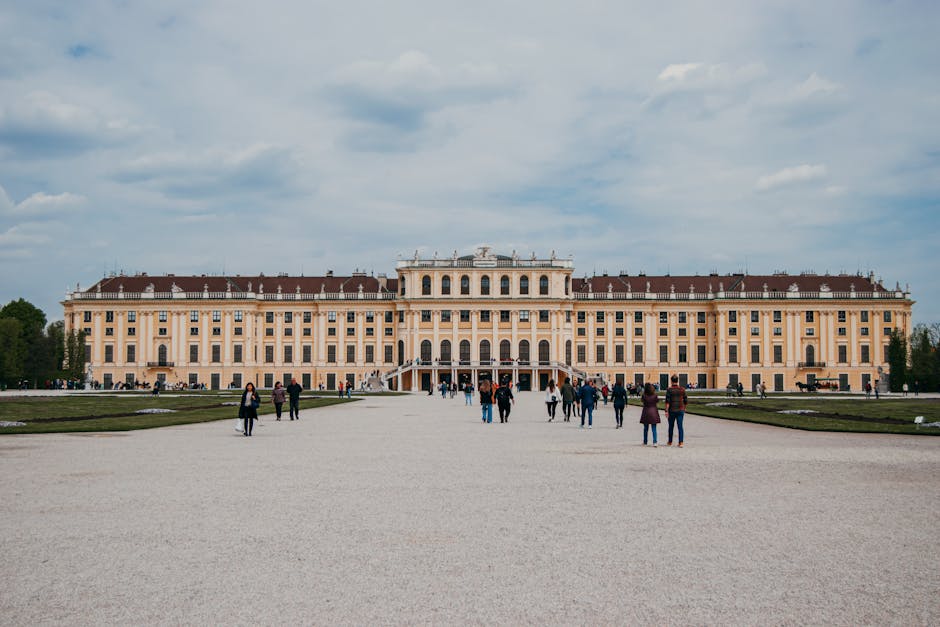
Then, there is the curation of emptiness. The vast gravel forecourts around the main palace buildings are the most striking example. To an untrained eye, it might seem barren. But in that raked expanse, your perception sharpens. You notice the texture of the gravel, the play of light and shadow, the way it sets off the dark pine silhouettes and the white walls of the palace. It’s a canvas of calm that makes every intentional element—a single perfectly pruned pine, a stone lantern—sing with significance.
The planting philosophy is one of structured naturalism. You won’t find riotous, colorful flower borders. Instead, there are vast sweeps of azaleas, pruned into soft, cloud-like mounds (karikomi) that erupt in coordinated, subdued color in spring. Ancient pines are supported by intricate, almost artistic frameworks of bamboo and rope, a technique called yuki-tsuri, designed to protect their branches from heavy snow. It’s nature, but nature as interpreted by a centuries-old aesthetic code that values asymmetry, balance, and the beauty of weathered, mature forms.
A Living Classroom: Applications Beyond the Moat
The principles on display here aren’t locked behind the moat. They’ve become my most valuable tools, applicable in surprising ways. I once consulted for a corporate headquarters in Manhattan. The client wanted a “green space” in a bleak, windswept plaza. Throwing in a flower bed felt wrong. Instead, I thought of the Palace’s gravel sea.
We created a minimalist courtyard using a field of dark river stones, raked in a simple, linear pattern. We placed just three large, irregular boulders and a single, multi-stemmed Japanese maple off-center. The employees initially thought it was unfinished. But over months, I received notes saying it had become a place to pause and breathe, a visual “reset” from the screen-filled chaos inside. It didn’t entertain; it provided respite. That’s the power of this aesthetic—it manages psychological space as much as physical space.
Another lesson is in maintenance as art. We in the West often see maintenance as a chore—mowing, weeding, pruning to keep things tidy. In the Palace Gardens, maintenance is the art form. The meticulous care of each tree, the seasonal re-rakings, the cleaning of stone lanterns—this continuous, attentive engagement is what keeps the garden alive as a cultural artifact, not a fossil. I’ve applied this by designing gardens that are beautiful specifically in how they are cared for, making the process visible and valued, rather than hidden.
The Double-Edged Sword: Advantages and Inherent Tensions
The overwhelming advantage of this style is its timelessness and profound psychological impact. It creates spaces of deep calm and focused attention. It’s sustainable, favoring perennial structure over annual floral displays. It teaches respect for materials, for process, and for the passage of time.
However, it comes with built-in tensions. The first is accessibility of meaning. Without understanding the historical and philosophical context—wabi-sabi (acceptance of transience and imperfection), ma (the power of negative space), Zen Buddhism—it can be misinterpreted as sparse, boring, or even austere. I’ve seen tourists breeze through the East Gardens in twenty minutes, wondering what the fuss is about, while a Japanese grandmother might sit for an hour just watching the light on the moss.
Secondly, it can be stiflingly prescriptive. The weight of tradition is immense. There is a “correct” way to tie yuki-tsuri, a “correct” angle for a stepping stone. For a creative designer, this can feel restrictive. The line between preserving a living tradition and becoming a museum copyist is razor-thin. The gardens walk this line beautifully, but it’s a constant, deliberate effort.
A Personal Misstep and a Lasting Memory
Early in my career, I made a classic mistake. I designed a small meditation garden for a client, heavily inspired by the stone groupings I’d seen in the Palace Gardens’ Suwa-no-chaya teahouse area. I sourced beautiful, ancient-looking stones and placed them with what I thought was perfect asymmetry. It looked… off. It felt like a stage set.
My error was forgetting process over product. I had placed stones for an immediate visual effect. The masters who built those gardens would have lived with the stones for weeks, turning them, observing them in different lights, considering their relationship to the land’s history before committing. They weren’t decorating; they were composing with geological time. I had to dismantle my work and start again, this time with far more patience. Now, I spend as much time selecting and understanding my primary materials as I do placing them.
My most vivid memory is of a late afternoon in November. The tourist crowds had thinned. I was sitting on a bench near the old tenshudai (the base of the former castle keep), watching the low sun backlight a grove of ginkgo trees. Each fan-shaped leaf was a translucent, brilliant gold. A gentle breeze sent a shower of them drifting down, catching the light like flakes of fire. In that moment, the garden demonstrated its ultimate principle: it is a framework for experiencing ephemeral beauty. It sets the stage, then gets out of the way, allowing you to have a direct, personal encounter with a perfect, fleeting moment. No plaque could explain that. You just had to be there, quiet enough to see it.
Not the Only Path: Comparisons and Contexts
It’s tempting to hold the Imperial Palace Gardens as the pinnacle, but that would be unfair. It exists in a rich ecosystem of garden styles. Compare it to the flamboyant, colorful aesthetics of English Romantic gardens like Stourhead, which are pictorial and narrative, designed to evoke emotion and literature. Or the Renaissance gardens of Italy, which assert human reason and geometry over the landscape. The Palace Gardens are neither pictorial nor purely geometric. They are experiential and philosophical.
Even within Japan, it differs from the pure Zen abstraction of Ryoan-ji’s rock garden in Kyoto or the stunning scenic “stroll gardens” like Koraku-en. The Palace Gardens have a public, representational duty. They must be majestic, accessible (to a degree), and symbolic of the state, while still adhering to core aesthetic principles. This makes them a unique hybrid—part national monument, part serene retreat, and a masterclass in landscape restraint.
Pitfalls for the Enthusiast and the Designer
For visitors, the biggest pitfall is rushing. This garden does not reveal itself to a speed-walker. You must slow down. Sit. Watch how the light moves. Notice how a single camellia bloom looks against a dark evergreen. The garden works on a different clock.
For designers like myself, the pitfalls are more technical. Literalism is a danger—slavishly copying elements without understanding their context or proportional relationships. A stone lantern plopped into a suburban backyard looks kitschy, not contemplative. Another is over-pruning. The pruning here looks natural, but it is intensely skilled. Amateur attempts often result in butchered trees that look tortured, not sculpted. The goal is to help the tree achieve its most beautiful, healthy form, not to force it into an unnatural shape.
Finally, there’s the pitfall of importing the aesthetic without the culture. Creating a “Zen garden” as a stress-relief trend misses the profound spiritual and philosophical roots that give the form its depth and authenticity. It becomes a lifestyle accessory, not a space for genuine reflection.
The Future: Preservation in a Changing World
The future of the Imperial Palace Gardens is one of vigilant preservation in the face of environmental and social change. Climate change is a silent threat. The delicate mosses, the ancient pines, the specific microclimates—all are vulnerable to shifting weather patterns, hotter summers, and more violent storms. The gardening team, the ueki-shi, are now not just artists and historians, but climate adaptation specialists.
Socially, the gardens face the challenge of remaining relevant. As Japan’s population ages and urbanizes, how does this vast, quiet space in the center of a hyper-modern city stay connected to younger generations? The occasional public tours of the inner grounds and the New Year’s greetings are a start, but the deeper connection—the understanding of the quiet, slow values the garden represents—requires active cultural nurturing.
I believe their role will only become more critical. In a world of digital noise and constant stimulation, the gardens offer a necessary antidote: a physically manifested lesson in silence, patience, and paying attention. They are a sanctuary of slowness. They don’t need to become “interactive” or “high-tech”; their power lies in their unwavering commitment to being the opposite.
Final Thoughts
The Imperial Palace Gardens taught me that the highest form of design isn’t about what you put in, but what you have the confidence to leave out. It’s a landscape that trusts the viewer to complete the scene with their own contemplation. My career has been a long, slow process of unlearning my instinct to fill space and learning instead to honor it.
If you ever find yourself in Tokyo, make the time to visit. Don’t just go to check a box. Go with slow feet and an open mind. Sit by the moat and watch the shadows lengthen across the stone. That feeling of expansive calm you’ll carry back into the neon rush of the city—that’s the garden’s real gift. It’s not a relic of the past, but a timeless, living manual for how to find stillness, no matter what century you’re in.