The Pulse of Tokyo: Navigating the Beautiful Chaos of Shibuya Crossing
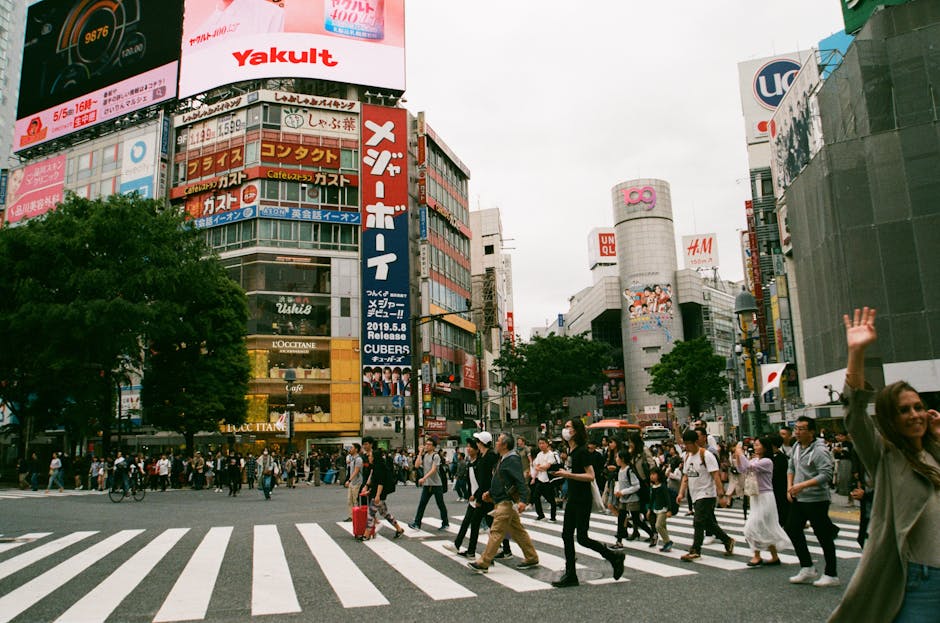
I remember the first time I stood at the edge of that famous intersection, clutching a map that was already damp from the humidity. I’d seen it in movies, of course—Lost in Translation made it iconic for a generation—but nothing prepares you for the physical sensation. It wasn’t just the sight of a thousand people moving in orchestrated chaos; it was the sound, a low, rushing hum of footsteps and murmured conversations, punctuated by the relentless click of pedestrian signals. And the smell—a faint mix of concrete, exhaust from the idling taxis, and the sweet, buttery scent of fresh taiyaki from a nearby stall. I wasn’t just observing Shibuya Crossing; I was being absorbed by it. That was over a decade ago, and since then, I’ve crossed it in every conceivable state: jet-lagged and bewildered, purposefully late for a meeting, or simply as a spectator, coffee in hand, from the second-floor window of the Starbucks that serves as the world’s most popular theatre box seat.
For many, it’s a bucket-list photo op. For me, it became a fascinating case study in urban design, human behavior, and the living identity of a city. It’s a place where the theory of how a metropolis should work collides, beautifully, with the messy, vibrant reality of how it actually does.
More Than Just an Intersection: A Brief History in Flux
To call Shibuya Crossing an “intersection” feels like calling the Pacific Ocean “a body of water.” It’s technically accurate but misses the profound scale. The crossing exists as the literal and metaphorical heart of Shibuya, a district whose name once meant “Bitter Valley.” Its transformation is the story of modern Tokyo itself.
In the early 20th century, this was just another junction near the busy Shibuya Station, which served the growing suburbs. The real catalyst was the 1964 Tokyo Olympics. Japan was on a global stage, showcasing its post-war recovery and technological prowess. Infrastructure exploded. The Toyoko and Inokashira railway lines were elevated, and the famous “Hachikō” exit was born, named for the loyal dog whose statue remains the district’s most beloved meeting point. The crossing, in its nascent form, began to handle flows of people that would cripple a typical city square.
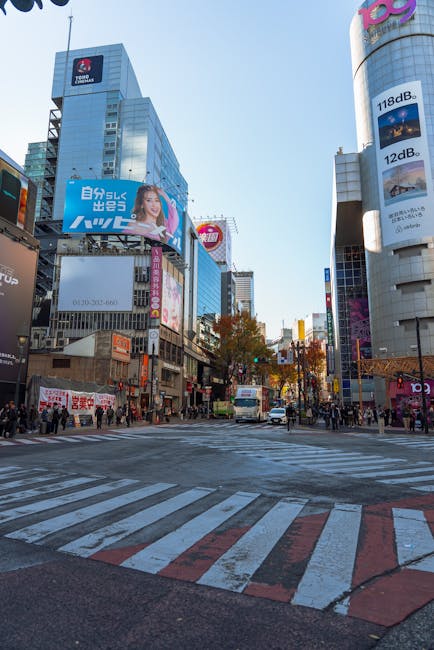
But the crossing you see today is a product of the Bubble Economy era of the 1980s and the digital age that followed. The giant video screens plastered on buildings like the QFRONT and Shibuya 109 aren’t just advertisements; they are the walls of the canyon, broadcasting a hypnotic stream of pop stars, anime, and fashion. They transformed the space from a transit hub into a immersive media experience. The 2019 massive redevelopment of the area around the station, including the new Shibuya Scramble Square and its breathtaking “SHIBUYA SKY” observatory, formalized what had long been true: the crossing isn’t just a place you pass through. It’s a destination. It’s the town square for a nation with very few traditional ones.
The Mechanics of the Scramble: How the Magic Happens
So, how does this system not devolve into utter pandemonium? There’s a sublime, almost invisible engineering at play. It’s a “scramble crossing,” or sukuranburu kōsaten, meaning all vehicle traffic in every direction is stopped simultaneously, freeing pedestrians to cross not just straight across, but diagonally, in a vast, swirling human pool.
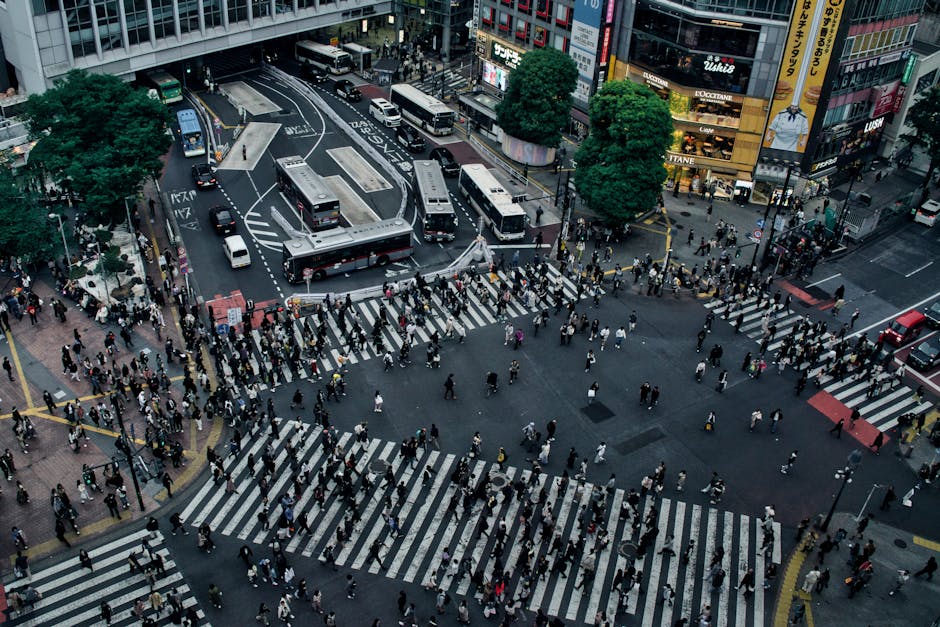
The rhythm is everything. Stand there long enough and you feel it in your bones. For about two minutes, traffic flows—the iconic green midori taxis, delivery trucks, and a sea of scooters navigate the multi-lane roads. Then, a distinctive, rapid-fire pi-pi-pi-pi chirping begins. It’s the pedestrian signal, a sound so ingrained in the Japanese psyche it’s been used in music tracks. This is the warning. The crowds at all five corners (it’s not a simple four-way cross) press forward, leaning into the tape. The traffic lights turn red in perfect unison. There’s a heartbeat of silence.
And then, the flood.
For about 45 to 90 seconds, up to 3,000 people pour into the intersection. What looks like chaos from above is, from within, a surprisingly orderly flow. There’s an unspoken etiquette: you keep moving, you don’t suddenly stop for a photo (a cardinal sin that will earn you sharp glances), and you navigate by subtle shoulder shifts and eye contact. It’s a masterclass in collective, non-verbal cooperation. The system works because everyone implicitly trusts it—and each other—to work. When the slow, blinking green man (aotan) appears, the flow reverses, draining back to the sidewalks with remarkable efficiency, just as the first rev of scooter engines signals the return of traffic.
The Real-World Laboratory: What the Crossing Teaches Us
Beyond tourism, Shibuya Crossing functions as a living laboratory with surprising applications.
For Urban Planners: It’s the ultimate test of pedestrian-first design. Cities like London, New York, and Toronto have since implemented their own scramble crossings, but none at this scale or cultural significance. Shibuya proves that giving pedestrians temporal, if not spatial, dominance can dramatically improve flow and safety in hyper-dense areas. The recent renovations widened sidewalks, added greenery, and created multi-level access, showing a clear evolution from pure efficiency to creating a more livable public space.
For Technologists and Marketers: The crossing is a data goldmine. Those cameras aren’t just for security; they anonymously track crowd density, flow patterns, and even demographics. This data informs everything from train scheduling to disaster preparedness. For advertisers, it’s the world’s largest real-time focus group. Launching a new product? A music video? If it can stop someone for a fraction of a second amidst the flow, it’s a success. The 2018 collaboration between the tech company Six and the artist 8810ma to create an interactive, music-responsive light show on the crossing pavement was a glimpse into a future where the ground itself becomes a dynamic canvas.
For Sociologists and Psychologists: It’s a Petri dish of human behavior. You see the “follow-the-leader” instinct in action, the formation of temporary micro-communities (the group of tourists huddling together), and fascinating cultural norms. Notice how rarely people bump into each other, and if they do, a quick, slight bow or sumimasen (excuse me) is exchanged without breaking stride. It’s a dance of apology and forgiveness performed hundreds of times a minute.
The Glitter and the Grind: Advantages and Inconvenient Truths
The advantages are visceral: it’s efficient, iconic, and embodies the energetic, forward-moving spirit of Tokyo. It’s a democratic space where salarymen, fashionistas, tourists, and teenagers all share the same concrete stage. It generates an undeniable sense of being part of something vast and alive.
But it has its downsides, especially for those who deal with it daily. The crowds can be oppressive, especially during peak hours or on a rainy Friday night. For people with mobility issues or parents with strollers, the scramble can be a stressful gauntlet rather than a spectacle. The constant sensory bombardment—the screens, the noise, the press of people—can lead to what I call “Shibuya Fatigue,” a particular brand of urban exhaustion. And while it’s generally safe, its very popularity makes it a potential target, leading to a noticeable, if discreet, security presence during major events.
A Personal Chronicle: Lessons from the Scramble
I’ve learned more from watching and crossing Shibuya than from any urban studies textbook. Here are a few hard-won insights:
- The Best View Isn’t from the Ground: Every first-timer wants to be in the scramble. The seasoned observer finds a perch. The Starbucks in the Tsutaya building is the classic, but it’s perennially packed. The new SHIBUYA SKY observation deck offers a breathtaking, god’s-eye view. My personal favorite is the L’Occitane Café on the second floor of its building—fewer crowds, great coffee, and a panoramic window.
- Timing is Everything: Want to experience the crossing without being crushed? Go early on a Sunday morning. The district feels hollowed out, a stark contrast to its usual self. For the full, overwhelming spectacle, 7 PM on a Saturday is your moment. For photography, the “blue hour” just after sunset, when the sky is dark but the neon is blazing, is pure magic.
- The Meeting Point Paradox: “Meet me at Hachikō” is the most common instruction in Tokyo. It’s also the most futile during peak times. You could be three people away from someone and never see them. I always specify a side of the statue (“Hachikō, on the station side”) or, better yet, pick a less chaotic landmark like the nearby Moyai Statue.
- A Case Study in Patience: Once, I was trying to film a time-lapse from a fixed spot. A security guard politely but firmly asked me to stop, as tripods are often prohibited in the busiest areas without a permit. It was a reminder that this is a functioning transit hub first, a tourist attraction second. The lesson? Always observe local rules and be respectful. Your Instagram shot isn’t as important as public safety and flow.
What It’s Not: The Shinjuku and Shimbashi Comparison
People often ask how it compares to other busy Tokyo spots. Shinjuku Station may move more people in total, but it’s a labyrinthine interior, a maze of corridors and platforms. The experience is claustrophobic and directional. Shibuya’s crossing is an explosive, open-air release.
Shimbashi’s Salaryman Scramble is another famous crossing, but it serves a different purpose. It’s a pure, functional vortex of men and women in dark suits rushing to and from work. It lacks the cultural weight, the fashion, the giant screens—the theatre of Shibuya. Shibuya is where you go to be seen; Shimbashi is where you go because you have to be at the office.
Common Pitfalls and How to Sidestep Them
- The Sudden Stop: Freezing in the middle of the scramble to take a photo or get your bearings is the number one faux pas. It disrupts the flow and can cause minor pile-ups. If you must capture the moment, keep moving to the edges or use a raised camera without stopping.
- Underestimating the Crowd: Think you can just “dash across” against the light? Don’t. The traffic starts precisely on time, and the drivers are expecting a clear intersection. It’s incredibly dangerous.
- The Baggage Problem: Large suitcases or backpacks become battering rams. If you’re transiting through Shibuya Station with luggage, use the underground passages. They’re less scenic but far more civilized for you and everyone else.
- Missing the Context: Seeing only the crossing is like reading only the climax of a novel. Wander the backstreets (ura-Shibuya), explore the curated madness of Center Gai, or find a tiny bar in Nonbei Yokocho (Drunkard’s Alley). The crossing is the spectacular finale, but the district is the full story.
The Future: An Evolving Canvas
The crossing will never be “finished.” It’s a perpetual work in progress. The 2020 Olympics spurred another wave of development, making the area more accessible and adding green spaces. The future I see is one of increased integration between the digital and physical.
We’ll see more augmented reality experiences—point your phone at the crossing and see historical overlays or interactive art. The data collection will become more sophisticated, used for real-time crowd management and even more personalized advertising. Sustainability will become a bigger focus, with potential innovations in energy generation from the pressure of thousands of footsteps.
But the core appeal will remain human. No matter how much tech is layered on, the thrill is in the collective, temporary community—that shared, wordless agreement among strangers to move together, to create order from potential chaos, and then to dissolve back into the city.
Shibuya Crossing is more than infrastructure. It’s a metaphor for Tokyo itself: seemingly chaotic, yet underpinned by deep-seated order; relentlessly modern, yet constantly honoring its past (just look at Hachikō, forever waiting); overwhelming, yet capable of moments of surprising, impersonal intimacy. You don’t just visit it. You experience it, you navigate it, and for a brief moment, you are a pixel in its magnificent, ever-changing picture. The next time you find yourself at that corner, waiting for the pi-pi-pi-pi to begin, don’t just think about your destination. Take a breath, feel the collective anticipation, and step into the scramble. You’re not just crossing a street. You’re participating in a daily ritual that defines one of the world’s greatest cities.