Tokyo Tower: My Love Affair with a City’s Beating Heart
I first saw it from a bus window, a sliver of orange and white cutting through a grey, drizzly Tokyo afternoon. It was 2007, and I was a student, hopelessly lost and jet-lagged. The map in my hands was a confusing tangle of lines, but there it was—Tokyo Tower, piercing the low cloud cover like a steadfast sentinel. In that moment, it wasn’t just a tourist attraction; it was a landmark in the most literal sense. It gave me a point to navigate from, a fixed star in the swirling galaxy of Shinbashi and Roppongi. That was the beginning. What started as a navigational aid became a personal compass, a structure I’ve returned to dozens of times over the years, each visit revealing a new layer of its story.
Many visitors, especially first-timers, rush to the newer, sleeker Tokyo Skytree these days. And I get it—Skytree is a marvel of modern engineering. But to me, Tokyo Tower has soul. It’s the patina on an old leather jacket versus the sheen of a new smartphone. It’s a testament to a city’s gritty post-war determination and its enduring, slightly nostalgic charm. This isn’t just a tower; it’s the emotional and architectural bedrock of modern Tokyo.
The Dream That Rose from the Ashes: A History Forged in Steel and Ambition
To understand Tokyo Tower, you have to understand the Japan of the 1950s. The country was in the midst of its remarkable post-war economic miracle, but physically and psychologically, scars remained. There was a burning desire to build, to symbolize a new, forward-looking Japan. Television was exploding in popularity, but broadcast signals in the Kanto region were a mess, hampered by Tokyo’s dense urban landscape.
Enter Hisakichi Maeda, founder of Nippon Denpatō (Japan Radio Tower). His vision was audacious: build the tallest self-supporting steel tower in the world, surpassing even the Eiffel Tower. The choice of design was no accident. The Eiffel Tower was the undisputed global icon of structural elegance and ambition. By evoking it, Japan was making a statement: “We are back, and we belong on the world stage.” But this wasn’t mere imitation. Architect Tachū Naitō, a pioneer in earthquake-resistant design, took the basic latticework concept and made it distinctly Japanese—and distinctly safe for a nation sitting on the Pacific Ring of Fire.
The construction itself, from 1957 to 1958, is a case study in frenetic, focused effort. They used steel from American tanks left over from the Korean War—a poetic recycling of the tools of conflict into a symbol of communication and peace. A team of tobi shokunin, the fearless master steeplejacks of Japan, assembled the 4,000-ton structure at a breakneck pace, with zero fatal accidents. When it lit up on December 23, 1958, standing at 333 meters (13 meters taller than its Parisian inspiration), it wasn’t just a TV antenna. It was a beacon of national confidence.
More Than a Pretty Face: The Guts and Gears of a Working Icon
Here’s a mistake many make: thinking of Tokyo Tower as a retired relic. Walk up to its base on any given day, and you’ll feel the low hum of machinery. This tower works. Its primary function, broadcasting, is its lifeblood.
Originally built for analog TV, its lattice structure is essentially a giant antenna. The specific arrangement of its steel members isn’t just for aesthetic symmetry or strength; it’s calculated to transmit and receive specific radio frequencies with minimal interference. The two main observatories aren’t randomly placed either. The Main Observatory at 150 meters was ideal for the original broadcast range, while the smaller Top Observatory at 250 meters was added for higher-frequency transmissions and, of course, the views.
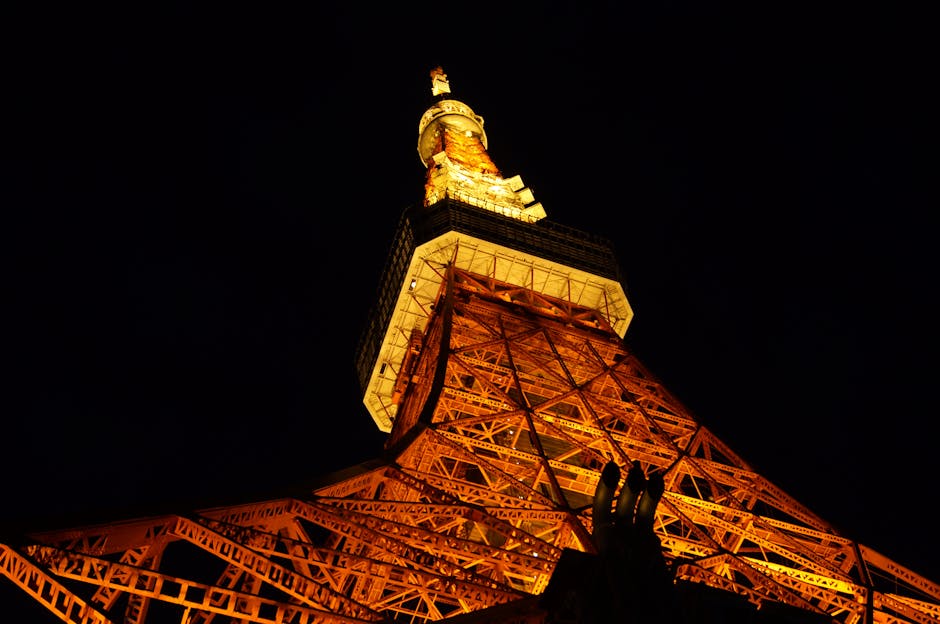
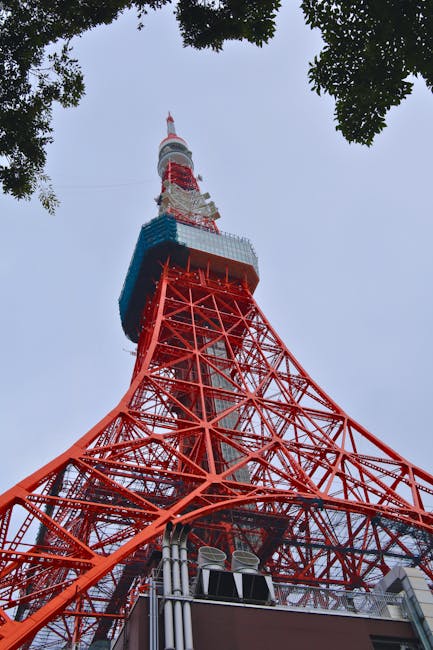
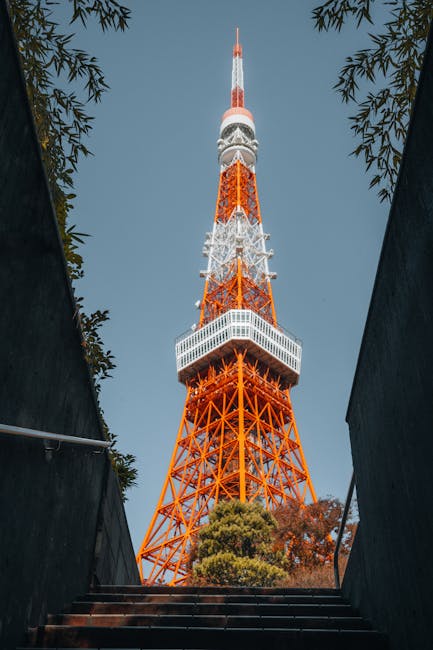
The most visible sign of its function is its paint job. That iconic “international orange” and white isn’t just for looks. It’s aviation safety paint, applied in carefully measured stripes to comply with aviation regulations. And it’s a mammoth task—a full repaint takes about a year to complete and happens once every five years. I once spoke to a veteran painter during a maintenance period who told me, “You learn the tower’s moods. The steel sings in the wind, and the sun on the south face feels different from the north. It’s like painting a living thing.”
Its resilience is its hidden superpower. Naitō’s design allows it to sway with earthquakes and typhoons rather than resist them rigidly. The lattice framework dissipates seismic forces. During the 2011 Great East Japan Earthquake, while the city shook violently, Tokyo Tower’s spire bent—designed to do so—and while it sustained damage, the core structure held. It was a powerful, visible testament to the engineering philosophy that built it: flexibility and endurance.
The Tower in the Wild: How Tokyo Lives With and Through Its Icon
Tokyo Tower’s applications extend far beyond broadcasting. Its role in the city’s ecosystem is multifaceted.
- The Ultimate Urban Waypoint: Before smartphone GPS, every meeting point in central Tokyo was defined in relation to the Tower. “I’ll meet you on the south side of Shiba Park, with the Tower behind you.” It’s the cardinal direction for a city without a grid. Even today, pilots on final approach to Haneda cite it as a key visual marker.
- Cultural Barometer: Look at the lighting. The standard white and orange illumination is for everyday. But the Tower’s lighting is a dynamic canvas. Special illumination events mark seasons, holidays, and causes. Pink for breast cancer awareness, rainbow for Pride, a somber blue for a national tragedy. During the 2020 lockdowns, its steady, warm glow felt like a message of perseverance to the empty streets below. It’s a 333-meter-tall mood ring for the metropolis.
- The Beating Heart of Pop Culture: Godzilla has smashed it. Anime characters fly past it. Countless dramas have used the FootTown promenade as a rendezvous or breakup spot. It’s a shorthand for “Tokyo” in any visual medium. My favorite personal memory is seeing a group of cosplayers from an obscure 90s anime posing meticulously with the Tower in the background—a perfect fusion of its real and fictional roles.
The View from Both Sides: Weighing the Tower’s Legacy
Spending so much time with Tokyo Tower means seeing its warts alongside its wonders.
Advantages:
- Unmatched Character: It has history etched into every beam. The 1950s retro-futurism of the interior decor in FootTown, the slight creak of the original elevator machinery—it’s a time capsule with a pulse.
- Superior Central Location: Nestled in Minato ward, it’s surrounded by temples (Zojo-ji), parks, and vibrant neighborhoods like Roppongi and Azabu. A visit here can be part of a rich, walkable day. Skytree, by comparison, feels more like a destination in itself.
- Affordability and Accessibility: The observation deck fees are significantly lower than Skytree’s. It’s also easier to get a ticket without a long, timed-entry wait, making it a more spontaneous, less commercialized experience.
- The “Classic” View: From the Main Observatory, you see the Tokyo of history and cinema—the Imperial Palace grounds, the dense clusters of Shinjuku, the curve of Tokyo Bay. It’s the postcard view that defined the city for decades.
Disadvantages:
- The Height Deficit: In a city now defined by Skytree’s staggering 634 meters, 333 meters can feel less awe-inspiring. You’re in the forest of mid-rise buildings, not soaring above a sea of them.
- Obsolescence Pressure: With the digital TV transition and Skytree taking over as the primary broadcast hub, its technical raison d’être has diminished. The struggle to remain relevant is real.
- Crowds and Kitsch: The lower observatory can get packed with tour groups, and parts of FootTown feel frozen in a 1980s bubblegum-pop idea of entertainment. It requires patience to find the quiet, profound moments.
A Personal Chronicle: Lessons from a Thousand Visits
I’ve made every mistake a Tower visitor can make. I’ve gone on a blindingly sunny Sunday afternoon and spent an hour in a shuffling queue. I’ve underestimated the wind chill on the Top Observatory in February—a cold that seeps into your bones. I’ve tried to take the perfect photo from the wrong side, with the sun glaring directly into the lens.
But I’ve also found magic. The best practice I’ve learned is to go just before sunset. Buy your ticket for the Main Observatory in the late afternoon. Watch the city bathed in golden hour light. Then, as dusk falls, watch the city transform. Office windows light up one by one, headlights become rivers of rubies and diamonds, and the city’s grid emerges in a breathtaking display. You get two views for the price of one. Then, take the elevator down and walk through Shiba Park towards Zojo-ji Temple as the Tower itself lights up behind the ancient pagodas. This contrast—the old and the new, the sacred and the secular—is Tokyo’s story in a single glance.
One rainy November evening, I had the observatory almost to myself. A salaryman in a slightly rumpled suit stood silently at the glass, a briefcase at his feet, staring at the glittering expanse of Shinagawa. He wasn’t taking photos. He was just… looking. I realized then that for Tokyoites, the Tower isn’t just for tourists. It’s a place for contemplation, to gain literal perspective on the city that demands so much of them. It’s a secular shrine to the metropolis itself.
The New Kid on the Block: Tokyo Tower vs. Tokyo Skytree
The comparison is inevitable. Skytree is the future: staggering, sleek, and efficient. Its Tembo Galleries offer views that are undeniably more spectacular. You feel like you’re in orbit. The surrounding Solamachi complex is a clean, modern marvel of retail and entertainment.
Tokyo Tower is the past that warmly insists on remaining present. Visiting Skytree feels like a technological experience. Visiting Tokyo Tower feels like a human one. It’s the difference between a flawless digital recording and a vinyl record with a few pops and cracks—the latter often holds more warmth and memory. Skytree shows you how big Tokyo has become. Tokyo Tower shows you where it came from.
The Road Ahead: Can an Icon Evolve?
The future of Tokyo Tower is the most fascinating chapter yet. Its managers are acutely aware they can’t just rest on nostalgic laurels. The ongoing renovation and rebranding efforts are focused on leaning into its heritage while creating new value.
The “Tokyo Tower 2.0” plan involves refreshing FootTown with more sophisticated dining and cultural spaces, emphasizing its role as a community hub rather than just a ticket hall. There’s talk of enhanced night-time experiences, using projection mapping on its interior shafts or creating more intimate viewing lounges. Its greatest asset—its history—is being leveraged through curated tours that focus on its engineering and post-war significance.
The goal is clear: transition from being just a “broadcast tower with a view” to being a “cultural transmitter.” To broadcast not just radio waves, but the story of Showa-era Japan to a new generation. I believe it will succeed not by trying to beat Skytree at its own game, but by playing a different one entirely. It will be the cozy, character-filled izakaya to Skytree’s gleaming, multi-story department store restaurant. Both are essential; both define Tokyo in different ways.
Standing the Test of Time
Tokyo Tower will never be the tallest again. Its broadcast duties will continue to lessen. But as I stood there on my last visit, watching a young couple point out their neighborhood window to their toddler, I realized its true function.
It is a steadying presence. A grandfather clock in a smartwatch world. In a city that demolishes and rebuilds at a dizzying pace, it is a constant. It has witnessed bubble economies and crashes, triumphs and tragedies, and through it all, it has simply stood, lit up the night, and offered a place from which to see the whole, magnificent, overwhelming picture.
My advice? Don’t just check it off a list. Go see Skytree, by all means. Be amazed. But then, come to Tokyo Tower. Go up as the sun dips low. Feel the slight vibration of the working city through the steel. Look for the older, smaller buildings huddled around its base, and the ancient temple gates framing its silhouette. You’re not just seeing a view. You’re touching the spine of modern Tokyo, and understanding that the city’s future is forever built upon the sturdy, orange-steel dreams of its past.